
December 13, 2012

23andMe’s Newest Feature Explores Your Ancestry

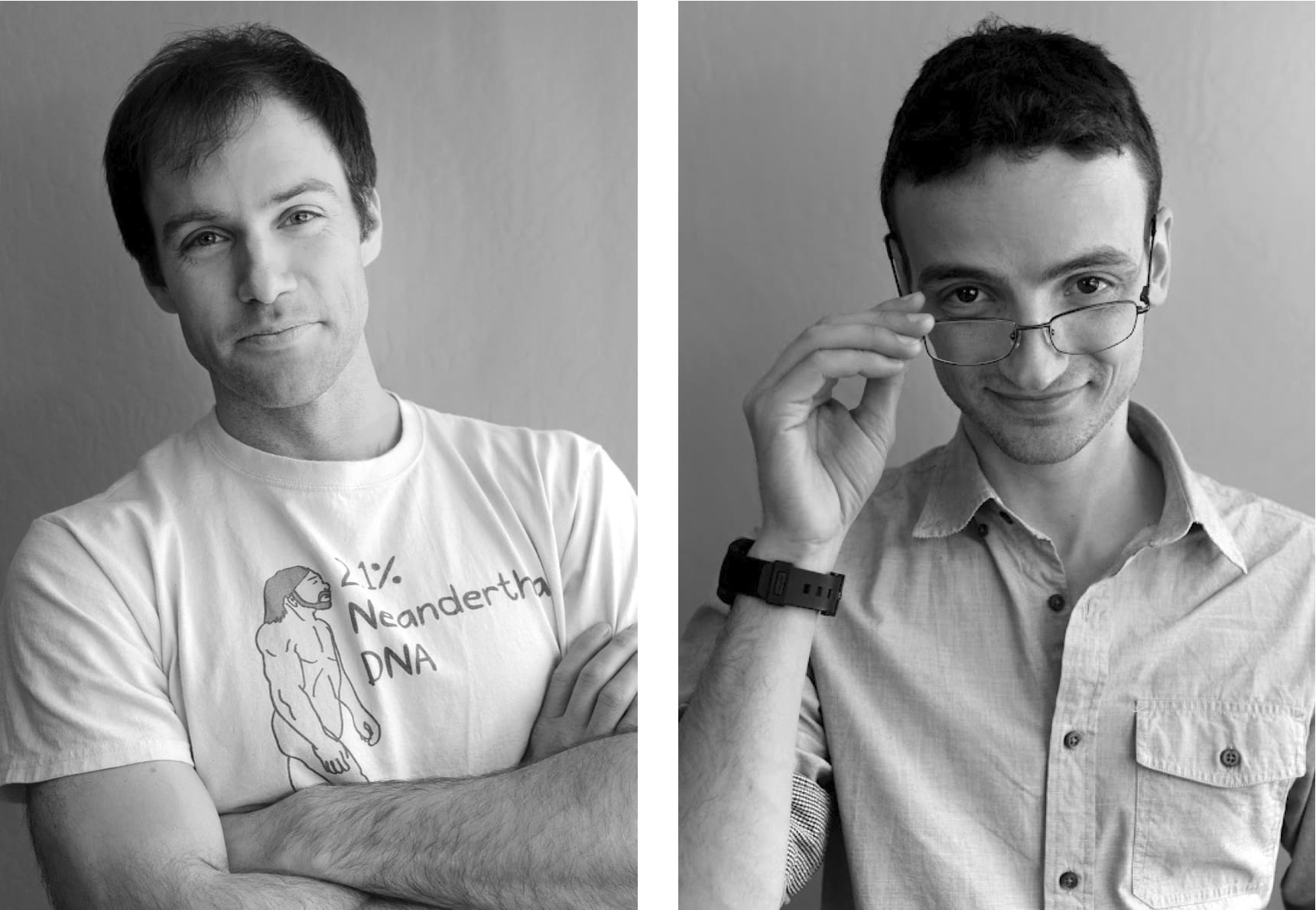
Mike and Eric

Our team rolled out a new feature called Ancestry Composition last week that will tell you more about what you’re made of, or more precisely, the geographic origins of your DNA.

Principal Product Scientist Mike Macpherson, former Research Scientist Chuong “Tom” Do, and Computational Biologist Eric Durand led the team that spent many months developing an innovative and accurate tool to determine your ancestry going as far back as 500 years.

One of the stunning aspects of Ancestry Composition is that it’s based on the newest advances in machine learning and thus will get better over time.

“Ancestry Composition is truly innovative. Not only does it use public-genetic databases for reference, it also uses the data set from 23andMe, so as more people join 23andMe, the more powerful and more accurate Ancestry Composition will become,” Mike said.
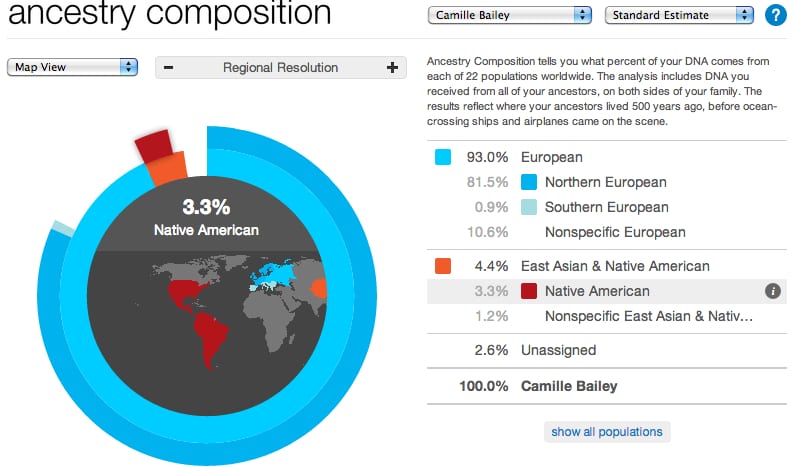
The feature can very accurately detail the mosaic of your ancestral background, distinguishing British and Irish ancestry, for instance, or telling you the breakdown of your Scandinavian or Italian ancestral origins. It’s also a powerful tool for finding Ashkenazi Jewish ancestry.

Right now, Ancestry Composition is particularly interesting for people of mixed ancestry: individuals who have Native American, Latino, African American or mixed European heritage.

It’s a great tool already and promises to keep getting better.

An update is planned in the near future to add more detail for people with African and Asian ancestry. This will give a finer level of detail and help customers zero in on the regions of their ancestral origins.

But the feature can be enlightening for people of any background offering a view of an individual’s genetic ancestry, breaking down the mix of ancestry by percentage and putting it all into an intuitive visualization.

There are several other bells and whistles for those who want to dive in and find a few fun surprises.

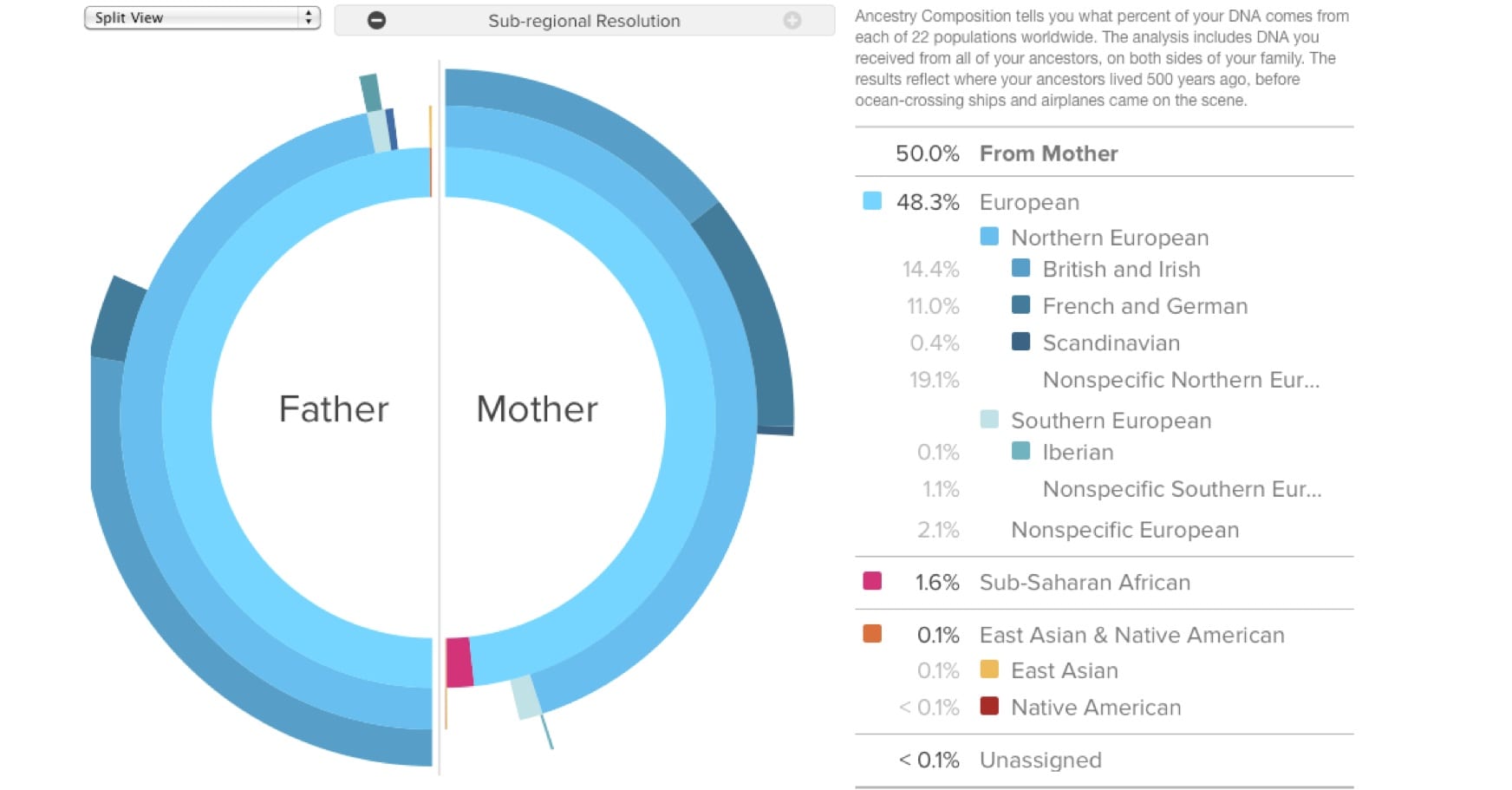
One of those is the Split View, which gives great detail for customers who have at least one parent also in the 23andMe community. If at least one parent has been tested and is linked through the Family Tree feature, Ancestry Composition’s Split View will tell you what mix of your ancestry comes from your mother and what mix of your ancestry comes from your father.

Another add-on to the feature is a Chromosome View, which “paints” the ancestry on each of your 23 chromosomes.

If you’d like to see more detail on how this has done you can look both at a white paper put together by Mike or a recent poster presented at the annual meeting of the American Society of Human Genetics, which outlines the technique.

The new feature replaces 23andMe’s “ancestry painting” and “global similarity,” two tools that were equally pioneering when they were first introduced. But with Ancestry Composition 23andMe breaks new ground and sets a new standard for determining genetic ancestry.

Twitter Facebook Google+ Email Email to a friend

You may also want to check out:


Comments

  1. Luke says:

    Very nice!

    Is it possible to get access to our raw results – i.e. the per-population probabilities for each chunk, along with the start and end locations? Or even just the best guess, probability and position for each chunk, if you didn’t save all the probabilities.

    • ScottH says:

      Luke,
      Thanks for the note. Mike Macpherson said that we don’t currently offer that access, but we’ll likely add something like this in the future. We do store the full posterior probabilities, and 23andMe will be offering access to Ancestry Composition results via our API starting later today.

  2. Patrick M. says:

    Does the ancestry also differentiate Metis from simply being of French/Scottish and Native descent?

    • ScottH says:

      We don’t specifically identify Metis ancestry — Canadians with mixed early European and Native American ancestry. But their Native American and European ancestry would indeed be identified and broken out with the Ancestry Composition feature.

  3. Bridget says:

    Congratulations on this new feature – it is fascinating! As a female, who does not have any paternal data in her profile, is my Ancestry Composition page only showing the results from my mtDNA?

    Thank you!

    • ScottH says:

      The short answer is no, Ancestry Composition includes autosomal DNA. That said you’d be able to learn quite a bit more about your ancestry if you also had a direct male relative tested — brother, father, paternal uncle, paternal granddad or paternal cousin.

  4. Maureen Martin says:

    This is beautiful! I have one suggestion, though. I know this service is web based and everything looks beautiful online…but…most of us would like a print out of this fascinating picture! Saving it as a screen shot is adequate, but our home printers just do not differentiate the subtle shadings of our European backgrounds. I would suggest very different colors for the sub-regions so we can get a clearer printout to frame!

  5. Davidski says:

    I’ve got one very important question…

    When is this thing going to get fixed for us reference samples?

    • ScottH says:

      Ancestry Composition is a really powerful and accurate analysis, and there is a fair bit of complexity underlying its power. 23andMe Community members have been really helpful in identifying a few cases where the analysis can be improved. Along with the updates to the East Asian and Sub-Saharan African reference data sets, we’re actively working on ironing out these cases so all customers have a great experience. We don’t have exact dates right now, but we’ll post progress updates in the 23andMe Community.

  6. Linda S says:

    This feature seems interesting; however, I have 26.1% Non-specific European, 0.3% Non-specific Native American, and 2.8% unassigned? This is confusing and seems to be a rather large amount of my DNA that is not identified. Will there be more data in the future?

    • ScottH says:

      The short answer to your question is yes. With more reference data we’ll be able to return more specific results. In making the assignments for Ancestry Composition we err on the side of accuracy. We would rather our assignments be based on solid science. If you haven’t already see it this white paper will explain how assignments are made. Essentially when we do not have enough data to make the call, and no group of populations reaches the threshold we have set to make that assignment, we’ll report “Unassigned.” We’ve built in three confidence thresholds to Ancestry Composition. These are Speculative (50 percent), Standard (75 percent), and Conservative (90 percent). You can select any one of those three settings to see how your results would change with different thresholds.

  7. Kimmo Palin says:

    More resolution please! ;) Is there plans to provide finer grained ancestry mapping for individuals from well sampled populations? As you say in the Ancestry Composition Guide page, you should be able to place an europeans ancestry to within 100 miles. I’d love to get more information about my ancestry than the current “99.9% Finn”

    • ScottH says:

      We do have plans to update in the coming weeks what is returned for people of African and Asian ancestry. But the feature has been built to improve over time, so we expect that over time it will return ever finer grained ancestry mapping.

      • Lemba says:

        I am very excited for the Africa/asiani being broken out, finally! This is great news for a person of quad-racial mixture. One clarification, when you say Asian ancestry are you also referign to the Native being broken out? I have noticed a clear pattern that people who are substantially native have a high % of unassigned and it is related to parts of the genome which are NORTH-native american, there are reference datasets wtih na-dene and greenlanders, i think this will suffice if those datasets have enough markers, to add north-natives. Also is there a plan to fix the mideast/italian mixup issue in the next update?

      • Matt says:

        Any word yet on when there will be updates for Asian ancestry in the Ancestry Composition? I think the current comparisons of people as either closer to China or Japan are quite inaccurate, particularly considering how big of a country China is. It would be nice to see a further breakdown in 23andme the way some third-party tools use (and to compare those with 23andme’s research too!)

        • ScottH says:

          Hi Matt, We do plan on updating Ancestry Composition with more reference data related to African populations and Asian populations. That will be done in the near future. We don’t yet have a date, but soon. We’ll give notice in the blog when that’s up and running.

        • Norman says:

          I just ordered a testing kit and I am hoping to confirm/figure out what turned up in my Genographic 2.0 results.

          According to the “Our Story” section of my results, my haplogroup is 02B1A2A.

          From what I have been able to gather from the web, this is a primary marker for a substantial percentage of the Japanese and Korean populations and is found in very small percentages of Thai and Vietnamese people.

          My families are from Southern China, so this result was a bit of a surprise for me.

          Will the current East Asian dataset provide some granularity to my results so I can sort this out? If not, will the future updates allow me to do so?

          Thanks.

  8. David Sawyer says:

    So at this time, you are unable to differentiate specific tribal ancestry (i.e. Cherokee, Cree, Lakota) among native Americans with this test? Is there away to do this and if so, what is it called and where can we have it done?

    • ScottH says:

      You are correct, we do not differentiate between specific tribal ancestry. The issue is that right now there are not good reference data sets to use to determine tribal origins.

  9. Davidp says:

    Dumb question, but if my results indicate a tiny % of East Asian ancestry, does this mean that 500 years ago I had an East Asian ancestor, or that sometime before 500 years ago there was an ancestor? (possibly 10,000 years ago, for instance). Just trying to figure it all out. Fascinating!
    Thanks

  10. Luis says:

    A lot of people who are not part of the reference samples are getting high percentages of unassigned southern European, European or nonassigned in general. Plus, many people from far away places are getting a lot of Italian too. Some people who score higher than average Middle Eastern on all of the other calculators and tests: Dodecad, DNA Tribes, Eurogenes, McDonald’s etc. are getting a very small % here. I think you should look into these questions.

    • ScottH says:

      Luis, Thanks for the comments. 23andMe Community members have helped us identify a few issues that have come up with reference populations. We’re fixing those issues and will soon have updates adding in East Asian and Sub-Saharan African reference populations, which will return more detailed results for customers with African and East Asian ancestry. We want to ensure that all customers have the same great experience exploring their ancestry.

      • J Winterberg says:

        The Middle Eastern ancestry seems very broad — especially since parts of the Middle East, like Lebanon and Syria, appear quite distinct. Is there any plan to drill down within that region as you have among European? (Currently, my mother and I are showing large parts of Italian heritage that we have no known record of, whereas we have record of our Lebanese ancestors and those percentages are not showing up under the Middle East category of this tool.)

  11. Andru says:

    But many ppl are immigrants… If you use their DNA data and their current country, it will mess up the entire database.

    • ScottH says:

      Thanks for the note. We have ways to ensure that the people we use in our reference population datasets actually represent the ancestry we want referenced.

  12. Ellen says:

    I’m having a hard time discerning the differences between the different shades of blue-green on my all-European chromosome map (particularly when I look at the “speculative estimate”. Is there any chance of adjusting the colors to make it easier to tell them apart?

  13. LH says:

    So no more PCA (Principal Component Analysis) of global populations?

  14. Joyce says:

    I have ordered 2 test kits and am ordering 2 more. But can you tell me. I have a large family or just friends that have to same last name and we are trying to make a connection.we want to send in male and frmale test to family members that go back to the beginning as far as we can. would this be able to tell us if there is a connection. or if our D.N.A matches at some point..

    • ScottH says:

      Joyce, In answer to your question, yes we can determine if two people are related and how closely. But no we can’t go back to “the beginning.” In terms of finding cousins we can find distant cousins who share a common ancestor many generations back perhaps six or seven generations. That said we do also look at deep ancestry by tracking paternal and maternal haplogroups. These lines really tell you more about where your very distant ancestors came from and the common line you share with a much broader group of people.

      • carolyn says:

        Why can’t we see closer cousins and relatives instead of 3rs 4th 5th 6th and so on?

        • ScottH says:

          Carolyn, You can see closer cousins if you match to someone who is a close relative in our database. That person would also have to opt in to Relative Finder to be able to see a match as would you.

  15. Karen says:

    My Italian family engaged in a lot of “clan” intermarriages, typically at the 3rd cousin relationship. Consequently, different lines converge at common ancestors. So if you are 4th cousins twice and perhaps also a 3rd cousin once removed, what does that do to the relationship results?

  16. Cynthia says:

    I understand that the DNA goes back 500 years ago, but how about the last 100 years? I was told I have American Indian in me from a couple of generations ago, but my results say 0%. Is this accurate?

  17. Melody says:

    Looks like my ancestry was updated, and now it’s showing something more like 0.1%, which makes way more sense to me.

  18. Robin says:

    My ancestry is showing about 22% Ashkenazi, but my relative finder is showing almost 100% Ashkenazi. How do I get to see the 78% of relatives from other branches of my ancestry?

    thanks,
    Robin

  19. Lauren McGuire says:

    I just ordered three kits – one for myself, one for my father and another for my son. I have been told that my ancestors are Russian, Polish and we think that my father’s grandfather was Italian. What can I expect in the analysis since both my father and myself are getting tested? Specifically, if there is Italian heritage, will it show up as such or undetermined European?

    Also, my son’s father was adopted with no known genetics for him. Will the ancestry breakdown for my son clearly be able to distinguish my ancestry vs. his fathers?

    • ScottH says:

      You should be able to see a breakdown of your European ancestry. What will be interesting is to see what was passed from your father to you and then on to your son. If your father’s grandfather was Italian, that should be fairly clear in both his and your ancestry compositions. It would be much harder if your Italian ancestor was from five or six generations back.
      Finally, about your son and what he will be able to discern. In the ancestry composition feature we have something called “split view” where a person can see what ancestry came from their mother and what came from their father. You must have at least one parent tested to be able to see the visualization, but because you’ve been tested he will be able to see that.

  20. Cherie Weitkamp says:

    If I have already given a sample can you find out more about my ancestors or do I have to do this again ?

    Cherie

  21. Randal says:

    I am new to 23and Me. I just got my Ancestry Composition a couple of days ago. I have tested with several other labs–FTDNA, Ancestry, EthnoAncestry, and Sorenson. I am projected by 23andMe to be 99.6% European, apparently of every stripe imaginable. I was surprised, however, to see 0.4% SSA. I understand that different labs use different data sets, and that 0.4% could be noise or some kind of artifact, but I’m still curious about the SSA, as no other autosomal test I’ve taken has indicated this particular ancestry. Could this be an indication of deep ancestry? I have my pedigree back several hundred years, and there is no indication of SSA in my background. This is fascinating, and I’d like to know more.

  22. ScottG says:

    Hi I just got my ancestry composition results back and its very interesting. However I was told that I have Black Dutch ancestry and possibly Native American ancestry. But it didnt come back with any results like that. My family has often time very dark and even “Asian” or “Native American” features that are clearly not Northern European. Do you know how to explain this? LOL

    • ScottH says:

      If your Native American ancestry goes back beyond 200 years — beyond six generations back — the DNA signal may be too hard to see. That said often times a person’s physical features — their phenotype — may not really be a good indication of their ancestral origins. Without knowing what your ancestral composition is — the percentage of European, Asian or African ancestry you have and where that ancestry is from (ie. Northern or Southern Europe), it would be hard to say more.

      • ScottG says:

        Here is the Standard Estimate to the composition: 99.7%
        European

        Northern European
        20.1%
        British and Irish
        0.3%
        Scandinavian
        64.7%
        Nonspecific Northern European
        1.4%
        Eastern European

        Southern European
        0.8%
        Sardinian
        0.1%
        Nonspecific Southern European
        12.4%
        Nonspecific European
        0.3%
        Unassigned
        100%
        What I find interesting is that many of my immediate family have what some have called Hispanic or Latino appearances. And also my Grandmother on my Dad side could easily pass for a full blooded Mexican because Ive had some Mexican friends of mine say that. Or even a half blooded Native American. Just thought that maybe the “Unspecified” or “Unassigned” might account for some of it. Just wanted to see what you might take of it?

  23. ellen says:

    okay so mine they do not know anything cuz it says on the standard 11 percent nonspecific europe 42.6 percent nonspecific southern europe so i cant see if im from greece or italy. and then it says 3 percent unassigned so when are they going to better my results because i feel like they just basically told me i was mainly european and like 2 percent other stuff. which is like common sense. i feel that i got my money taken away from me and i’m pissed

    • ScottH says:

      Ellen,
      What you describe does indeed happen but it is pretty uncommon in people with ancestry in Southern Europe. You might try “speculative” view to see if that changes significantly the assignments that are made. In addition getting a parent or child genotyped will automatically improve the results you get from Ancestry Composition. In the case of a parent you will be able to get a split view and determine from which parent your ancestry different mix of ancestry came. You can also use additional tools to learn more about your ancestry by looking at your DNA Relative matches. This can tell you a lot about your ancestry, but it may take a little more leg work.
      Obviously we wish you were more satisfied with your results. The tool is constantly improving as we draw in more data we can refine the results. Those results are based on sound science. We set the thresholds that determine the results. We’d rather be conservative in how we report back data than to report back something that is incorrect.

  24. Ruben says:

    Dear ScottH,

    I was wondering how accurate the testing with 23andme will be if I test my dna to find out which country my biological father is from? My mother is Dutch and my biological father is unknown, but I have a mixed phenotype, a combination between mena and dutch

    • Ruben says:

      I would guess, but with 23andme I hope that I will get some clarifications on where my biological father is from. Witch region, country or even more specific.

      • ScottH says:

        In answer to this and your previous question, the test is very accurate, but you may not get all your questions answered. The Ancestry Composition breaks down your ancestry based on regions, but sometimes it cannot be more specific than “Northern European” or “Southern European.” Individuals who’ve had at least one parent tested and share them, will also get a split view of the ancestry. This can tell them from which parent they got their ancestry. In my case, for example, I received German, French and African ancestry from my mother, and English and Irish ancestry from my father. Because you are male you’ll also see both your maternal and paternal haplogroups. That can tell you a lot about your deeper ancestry. You’ll also see DNA Relative matches which can help you get more clues about your father and his ancestry.

        • Ruben says:

          Thank you very much for your answer, I will let my mother get one to.
          Let’s say if my father is from somewhere in North-Africa like Algeria for instance. Would I see this in my split results?

        • ScottH says:

          Ruben, If one of your parents is tested and then you share with them an identify them as your mother or father, we can display your Ancestry Composition in “Split View.” That will show you from which parent your mix of ancestry comes from, breaking down what comes from your father and what comes from your mother.

  25. ScottG says:

    Ive read about how our results get updated and change from time to time. How often dose this happen and how much of our results can change?

    • ScottH says:

      ScottG,
      We do update and add to our reports fairly regularly. We have a team of scientists who are constantly looking at newly reported genetic associations to see both if we have the coverage and if the science in the studies is strong enough to meet our criteria to report back to customers. We also have a team of researchers who are sorting through our own data looking for associations that we can publish on. The number of reports we give to customers continues to grow.

  26. ScottG says:

    Also has anyone heard about how something called OmniPop can also take information from any kind of DNA test including 23andme and can analyze them with their data base?

Leave a Comment

*

Return to top
Twitter Facebook Google+ Email Email to a friend