Tag: mtDNA


September 26, 2012

Back to School: Sex Chromosomes Quiz Results

chromosome

The 23rd Chromosome This month we’ve run a series of quizzes for the back-to-school season. Here’s are the answers to our third and final quiz. Congratulations to Toni K., who was selected randomly from the large group of test takers who got all the answers right. You can see how you did by comparing [...]

Read more…

September 19, 2012

Back to School: All About Sex… Chromosomes

where genes come from

We know you’ve been studying hard at 23andMe U., but you’ve still got one more quiz to complete. This one hinges on some of the genetic differences between men and women. So before you matriculate, here’s the last quiz. Now don’t sweat it, you’ll do fine and we’ll even give you some hints [...]

Read more…

October 23, 2009

Revealed: The Genetic Origin and History of an Elusive Anabaptist Community

Hutterer-Frauen_bei_der_Arbeit

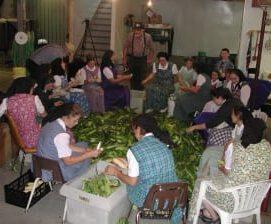
There are over 50,000 people in North America who define themselves as Hutterites, though you probably have never met one. One of the main branches of the Anabaptists, Hutterites live in self-sustaining communities throughout the rural northwestern United States and Canada. Like their sister branches, the [...]

Read more…

September 9, 2009

Europe’s First Farmers Came from Afar: New Clues Shed Light on Genetic Ancestry of Modern Europeans

iStock_000001256085XSmall

About 10,000 years ago, the prehistoric hunter-gatherers of Europe began meeting some new neighbors. These farmers spread gradually at first, expanding from the Near East through Anatolia and the Balkans. Then agriculture exploded, reaching present-day Britain within a few thousand years. The farmers [...]

Read more…

July 24, 2009

Direct Genetic Link between Australia and India Provides New Insight into the Origins of Australian Aborigines

istock_000009827014xsmall

In 1974, scientists digging in the dry lake bed of Lake Mungo in southeastern Australia uncovered the skeleton of a man preserved in the deep layers of sand and clay. Dating techniques eventually revealed that this individual died about 40,000 years ago. Scientists and the popular press dubbed the [...]

Read more…

July 22, 2009

Novel Techniques Suggest Neanderthal Populations Dwindled in the Face of Expanding Humans

neandertaler_reconst

The Neanderthals have always held a special place in the field of anthropology.  The skeletal remains of our short, stocky evolutionary relatives have been found everywhere from Spain to Iraq. Their physical likeness to our own species, and the possibility that humans and Neanderthals may have interacted, [...]

Read more…

July 8, 2009

DNA Analysis Confirms Remains of Famed 16th Century Astronomer Nicolaus Copernicus

nikolaus_kopernikus

Nicolaus Copernicus is probably the second most famous astronomer in history (after Galileo). He is best known for being the first to propose that the Earth circles the sun, and not the other way around. His theory ran into one problem, however. It was contrary both to conventional wisdom and Roman [...]

Read more…

July 2, 2009

People of the Veil: New Study Reveals Clues to Origins of the Nomadic Tuaregs

istock_000009227362xsmall

Not many people could survive the harsh conditions of the Sahara Desert.  Yet the Tuareg have lived in the the region for millennia. The Tuareg call themselves the Imazghan, meaning "free people." Today they are known for a distinctive dark blue turban worn by the men, and for their long history as [...]

Read more…

June 19, 2009

New Study Reveals Complex Origins of the Malagasy

istock_000005098054xsmall

Only 250 miles separates the island of Madagascar from the southeast coast of Africa.  The short distance between the two land masses traditionally led the outside world to assume that the native inhabitants of Madagascar - known as the Malagasy - originally came from the west, probably from the present day [...]

Read more…

June 9, 2009

Recalibrating the Genetic Clock: Scientists Develop New and Improved Method for Timing Prehistoric Human Migrations Using Mitochondrial DNA

clock

Just over 20 years ago, the first study using mitochondrial DNA (mtDNA) to trace prehistoric human migrations was published. In this seminal study, scientists managed to determine that all humans alive today can trace their maternal ancestry back to one woman who lived about 200,000 years ago in Africa. The [...]

Read more…

Return to top