
Genetics And That Striped Dress

The Dress

IMAGE: TUMBLR / SWIKED

Yeah, it’s that damn dress again.If you haven’t been online recently you might have missed it, otherwise you know exactly which striped dress we’re talking about. You know, the one that melted the Internet.So why are we bringing this whole thing up again? It turns out that what colors you see in those stripes has a lot to do with how old you are and where you grew up, according to new research done by scientists here at 23andMe.The huge amount of interest in this weird debate offered researchers at 23andMe a chance for an instant genetics experiment. A lot of people looked at that dress, but some people see white and gold, while others see blue and black.Why is that? Do our genes play an obvious role in the difference of how we perceive color? That’s what we wanted to know.

SathirapongsasutiF b:w

23andMe computational biologists Fah Sathirapongsasuti, PhD

 Buzzfeed and Wired both wrote about how our brains interpret light based on visual signals. The differences we see may be how our brains filter out different parts of the color spectrum. Alternatively, the differing density of our rod and cone cells or the cornea color could make some people see the world a bit more yellow or blue.The question is whether there is a clear biological reason for the difference. The short answer is that 23andMe researchers didn’t find any obvious genetic association for that difference. We’ll get to some of what we found a little later.First off it’s important to note that 23andMe regularly surveys customers asking them a slew of questions about their health, their traits and even seemingly odd queries about whether they can curl their tongues or do a somersault. When we combine all this information with their genetic information it feeds into a novel research platform that allows our scientists to learn more about the genetic influence on disease, traits and human behavior.So a few days ago we asked some of our customers who have consented to research about what colors they saw when they looked at that dress. About 25,000 people responded, and this is some of what our researchers learned.For one, there was no clear genetic association with seeing either a blue and black dress versus seeing a white and gold one, according to Fah Sathirapongsasuti, PhD, a computational biologist here at 23andMe.That doesn’t mean there is no association, it just means that we didn’t find one that met our threshold for a strong association. We did see a small effect size for a genetic variant in the gene ANO6. While this may or may not be significant, it’s interesting because ANO6 is in the anoctamins gene family, which includes the gene ANO2. The gene ANO2 is involved in light perception, so this might be something that warrants further study. But as we said, the association we saw did not show a big effect. Others who’ve looked at the possible genetic influence of how people perceive the color of the dress also did not find a strong genetic association, finding, for instance, that identical twins also reported seeing different colors.While we first looked at genetic associations with different color perceptions, we went on to see if there were other associations related to different phenotypes. The strongest association we found was with age. Our researchers found that the effect of age comes in two phases – for people up to 60 years old and for those who are over 60. According to our data the proportion of those who see white and gold increased up until the age of 60, but after 60 the proportion of those who see white and gold starts to decrease.Age EffectWe don’t know why that might be, according to Fah. Retinal cells responsible for color perception become less sensitive as we age, which could account for some of what our data show, but it doesn’t explain the different trends, he said.According to 23andMe’s data at around 20 years of age, customers were split evenly between those who saw a white and gold dress versus those who saw blue and black. But as customers get older the proportion of those who see white and gold increased up until the age of 60 when more than three quarters of those surveyed said they see a white and gold striped dress instead of blue and black one. This effect is more dramatic in men where the proportion of men seeing white and gold increases by almost 15% around the age of 40.Then, according to our data, after 60 years of age, the percentage of those who see a white and gold dress decreases at a steady rate. People over the age of 70 is the only group that see more blue and black than white and gold.Women, who were between the ages of 20 and 50,   were also slightly more likely to see white and gold.Our researchers also looked at whether other eye conditions – age related macular degeneration, cataracts and red-green color blindness – clearly influenced how color was perceived. Customers with cataracts were about 50 percent more likely to see black and blue instead of white and gold. Those who are color-blind were more likely to see white and gold, and there was not a strong effect with macular degeneration.Childhood ResidenceThe power of 23andMe research platform is that it allows scientists to look across all phenotypes and genotypes we record to find even unexpected associations.For instance, dress color perception appears to be influenced by the type of place you lived in as a child. Fah found that those who grew up in more urban areas saw white and gold at higher proportions than those who grew up in more rural areas.While results like these are interesting and could fuel multiple follow-on inquiries, this little experiment with the dress is interesting in another way. It’s instructive because it illustrates the complex interaction between both our genetics and environment.
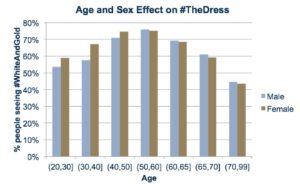
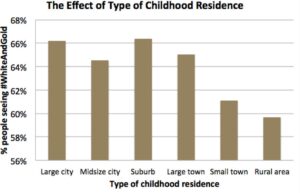

  • FelixZD

    What if the image starts at B/B and changes to W/G and never comes back? Such is the case for two times out of several I’ve seen the image (and manipulated and measured it in Gimp). The first was the 23AndMe survey image. The second is the image in this blog posting, seen thru a browser-based RSS reader.

    Very striking effect. In both cases, I wondered whether the image had been modified by a filter or lossy encoder. It was that surprising to see the B/B.

  • Sue

    It wasn’t an option on the survey, but for me I initially saw it as blue/black. Later I looked at the picture again and it looked white/gold.

  • TheMightyPOpe

    Did you correlate the answer to the time of day of the response? I would think it’s very likely that someone seeing the photo in sunlight may have a different perception than someone seeing it in artificial light or low light. I know, not really gene related, but if people live close to where they were born, the time of day would vary based on what time you sent our the initial email asking for responses, and thus perhaps more closely correlating to the time-of-day the question was answered. I see the dress now, in sunlight, and right now, for the first time, it looks like the colors reversed. This is coincidentally also the first time I see it in sunlight. Just a thought. You actually have data that could document this, unlike everyone else 🙂

  • Daniel Copeland

    This is very interesting and I appreciate 23andMe performing the research so quickly. I am curious if there may have been a bit of a sampling bias though. Considering how high of a proportion of people reported seeing the dress as white and gold, I wonder if they were more likely to reply to the survey as they knew they had seen the dress wrong. If I remember correctly one of the questions asked participants if they had seen the dress before. I am curious what the ratios of participants seeing blue+black vs white+gold are among the two sub-populations (previous exposure vs naive).

  • Leah

    It has always been blue and gold for me! 34 year old suburban female…however I have a neurological condition resulting from a brain injury, so I’m used to weird perception!

  • JCR

    I just thought it was how the color on you computer was set. It goes along with the disclaimer that the color of a product for sale may not be the same as you see in the picture.

  • Anneke9

    The dress looks light blue and gold to me, not white and gold. What does that say?

  • Arizona Eagletarian

    What about controlling for computer monitor color variations? Btw, I see blue and gold.

  • Gnome_de_Plume

    I was one of those surveyed. I had seen this meme on FaceBook and on the TV news. I was (and still am) irritated by the simplicity of the question. I am a visual person, trained in design. What I see when I look at the image was not any of the multiple choice answers offered. If we are talking just color, I see light blue and brown. I do not see black. However, I also see white and gold if I posit that I am looking at a dress in shadow. White turns blue like this when it is in the shade. The lack of light turns the gold into brown. Because of this, I do not think any scientific conclusions should be reached because the initial assumptions about the image are wrong.

  • Mike2011

    What about if you’ve seen both color variations?

    When I first saw the dress, it was white/gold. As I scrolled down the comments, I was stunned that some claimed to have seen blue/black. One commenter posted a photo in which the dress was clearly blue/black. Surprised, I scrolled back up to look at that original photo … and it now looked blue/black to me.

    I definitely thought something weird might have been going on in the composition of the photo. I read some articles about the phenomenon … but eventually let it pass.

    Several days later, I again saw the photo (I forget where). And again, it was white/gold. But then over the span of about 10 seconds, it gradually changed to blue/black before my very eyes. It was VERY weird to see this happening.

    Since then, I’ve seen the dress a few more times — including in the 23andMe e-mail and this blog post — and it’s always been blue/black.

    Go figure! 🙂

  • John Bigelow Taylor

    The dress is in reality blue and black. When it’s white-balanced on the blue, it turns gold and white. It’s as simple as that. Here is a picture of the two versions side by side. Can’t people see the difference? This whole discussion is crazy.

  • Laura Bu

    What colors I see depends on the angle of the computer screen. If the screen is at a 90 degree angle to the desk, the dress is gold and white. If it’s slanted back, the dress is blue and black.

  • John

    amazing

  • Christine

    I see blue and gold, so what does that mean? My husband saw blue and brown.

  • Drake Yeats

    I don’t think the dress thing is related to color vision ability. I think it is related to the ability to interpret colors in a photograph. Those are two very different skills because a color photograph can’t capture the full range of brightness levels in an outdoors scene where there is direct sunlight and shadow under a blue sky. Many people have never thought about the issues of capturing such a scene in a photograph, which involves color skills, a kind of artistic literacy. I bet that everyone seeing the dress in person would agree about what they’re seeing (white and gold, where the white has a bluish cast because it is in the shade). I made a YouTube video of what it looks like to manipulate the photograph’s brightness, contrast, color temperature, and color cast. Most people have never seen such a thing. https://www.youtube.com/watch?v=nVJI_iB_qUY

  • misanu

    I see brown and lavender and I grew up in a city. And I’m slightly less than 60. I think it’s psychological and the question was asked as a lead on. There were only two answers white/hold our blue/black. On the witness stand that’s called leading the witness. It is neither color. It’s brown and lavender because of the colors hues applied. So depending on the hues of the computer everyone saw a slight variation. But it was obviously blue and black which indeed it was!!!

  • Barbara Ribling

    I think it may just be simpler than what is being made of it. I see two
    obvious reasons for what is being seen. The first and most obvious
    reason has to do with monitor/tablet video options or video cards. I
    saw white and gold. This brings me to the second obvious observation.
    It has to do with the fact that the dress seemed (to me) to be in the
    shade on a sunny day. I immediately “compensated” for what seemed
    obvious to me. This is how a white and gold dress would look in the
    shade. I live on the Florida/Georgia border and have a good bit of
    sunshine year around. Most things I see are in the bright sun or in the
    shade so I have a good bit of experience observing things on sunny
    days. Simple.

  • Venus Aradia

    So what color is it?

  • Keith L

    But what about the few of us weirdos that see a blue and gold dress?!

  • BethRFinch

    Actually, I didn’t see either. I saw blue and brown. So I guess those of us who saw other colors weren’t counted.

  • Johnsen Johnsen

    Well, I saw the dress as white and golden yesterday but today the same picture is blue and black. I seem to be able to see it both ways and I’m able to change the colour while im glooming at the picture. How to explain this?

  • 1azww

    So I see a sky blue and gold. Does that suggest I’m “divergent?” 🙂

  • I see blue and brown. You didn’t even include those choices. I wonder if it has to do with computer screens?

  • Alette Simmons Jimenez

    Well I am confused – for my survey I saw white and gold. I went back again later the same day, and also now, in this post, I see blue and black. What would that mean?

  • nemo

    I actually see blue and gold 🙁

  • C Wilson

    This may be even more complicated than you have explained in this article . When I opened the e-mail message today, I first saw the dress on the message as gold and white. It changed to black and blue while I was looking at it. I closed the message and re-opened it, but the dress remained black and blue. I believe when I answered your survey, I saw black and blue the first time. Very odd.

  • John Bigelow Taylor

    I have posted twice about this dress and nothing ever appears here. I give up!

  • John Bigelow Taylor

    OK, now it does! I’ll try this again: The dress is in reality black and blue. It turns white and gold when you white-balance on the blue. That’s it. Really. Look at these two images side-by-side: the black and blue is the original dress from the manufacturer’s web site. The white and gold is what happens when I white-balance in Photoshop. Do they really look the same to any of you? Hint: the white and gold is on the left…

    • Dixie88

      on the left, I see light purple & shades of brown. on the right, I see bright royal blue & black

  • Bettina Jones

    Interesting….

  • Derek Bloomfield

    I saw blue and gold. Didn’t anyone else see it as I did?
    Derek

  • Jeremy Grand

    Objectively, what are the colors? Surely someone has measured this.

  • Trafalgar

    Have you considered the possibility that it might also depend on how your vision has adapted to the (light) environment you’re in, and what display you’re looking at? The majority of the time the dress has looked a light pastel blue and brownish beige for me (I chose white and gold because that wasn’t a choice), but twice now it has looked clearly blue and black on my windows phone when I was in a dark room and hadn’t been looking at my PC’s display.

    P.S. 23andme.com does not load on windows phones. It’s a bit of an inconvenience.

  • Mark Goho

    Very thankful to see this insightful write-up!

  • Keith L

    I see blue and gold as clear as day, so it’s freaking me out that I’m supposed to see either gold/white or black/blue. Any others who see blue and gold?

    • Ana

      That’s what I see, Keith: light blue and gold/tan

    • Sarah White

      I do, too.

  • Did you do any analyses that involve mapping candidate genes or regions in families? You write that “The power of 23andMe research platform is that it allows scientists to look across all phenotypes and genotypes we record to find even unexpected associations.” That’s great, and you report some interesting results. But you also have family data. I’m particularly interested in whether men who share any part of the X by descent are more likely to be concordant (to see the dress in the same way).

  • JHankwitz

    I see blue and various shades of gold.

  • Pat Mattern

    well, since I saw this dress as blue and gold (other), I guess I am a unique thinker or a follower since neither was the same and I chose one of both group.

  • S. C.

    Re: the striped dress…My husband and I and our 4 children (ages 18 to 25) all have 23 and me accounts. Only one of us was contacted for this survey. Very frustrating as I would have thought that data from the whole family would have been helpful and enlightening! In my family…husband(who grew up in a diff. place), wife, and 4 kids (2 boys, 2 girls who all grew up in the same city as me)…only my 20 yr old son saw the dress as blue and black, and he happened to be the one contacted for the survey.

  • Roeder

    I noticed that you didn’t discuss the results of the third option on your survey, “Switching between blue/black and white/gold.” This applies to me — this afternoon I saw black and blue, while right now I am seeing white and gold. I wonder if there are any theories that account for this.

  • thetagal

    I think it might have to do with the computer screens. It is clearly a periwinkle blue and beige, even on your graphs. Why not tell us what color the “real” dress is?

  • Gwanstadt

    The two overwhelming human variation effects are the modest age effect and
    the 50% increase in blue- black caused by cataracts (mostly age and
    environmental, not genetic, factors). Cataracts contain very small
    particles that scatter out more of the blue light. This is the same
    effect that makes the sky blue. Importantly, the light blue of the dress is sky
    blue.

    A surprising trick will allow you to see BOTH color combinations:

    1. to see white-gold: stand above your screen and look DOWN at the screen at
    about a 45 degree angle

    2. sky blue- black: (1) get below the screen and look UP at the screen at about
    a 45 degree angle.

    This effect is important enough so that the tilt angle you can select on most
    monitors makes a noticeable difference. Importantly, it does not works by
    turning your head 90 degrees to the sides and looking at 45 degrees… or by
    turning the screen 90 degrees. So, this difference is partly an artifact
    of the screen construction interacting with the viewing angle you have selected
    (screen tilt angle, head tilt angle, etc)!

    Second surprise: it is also partly an artifact of how you are
    construicted! You can also get the blue- black version by looking with
    your peripheral vision (e.g. sit squarely in front of the screen (90 degrees)
    and focus above the dress about 45 degrees; even better, look down 45
    degrees). This brings the light from the dress to a portion of the retina
    which has no color neuron photoreceptors, called “cones”, but does
    generate color signals in response to one light frequency, sky blue, from a
    different kind of neurons, the cell bodies of the third layer of ganglion
    cells; these control melatonin production, an important sleep / wake
    chemical. There are more of them in the “look down” part of the
    retina. Signals from these have not been thought to be part of color
    perception, but this suggests that they are, but of course just for sky
    blue. It will also vary depending upon how your visual cortex processes the
    signals, which is partly a learned phenomenon.

    But, this seems reversed- more people who get relatively less blue light to
    the back of their eyes (older, cataract suffers) see the blue. I am guessing
    that the sensitivity of these ganglion nerves in cataract folks have up
    regulated to compensate for being exposed to less signal on a daily basis, and so are reacting more to the relatively large blue signal from a LCD screen? Not sure. What do others think?

    Also, not sure why young people see more blue- black… Young people have
    more dilated pupils, and get a more light of all kinds to the back of the retina,
    and also deliver a higher blue proportion of the blue component to the retina (young have fewer particles to scatter light), which would seem to down regulate the sky blue
    sensitivity as a protective mechanism. Perhaps the thicker retina of
    youth is absorbing more of the blue, and this is the dominant factor that is up regulating the sensitivity of the ganglion layer cells behind?

  • Tim Jackson

    I see blue and gold stripes on the dress, does anyone else see that color pattern?

    • I do. I thought I was the only one in the world who did!

  • Karen

    It seems this should spark a discussion of the colors we see when we
    view anything. This one time someone asked – and this sparked the
    realization that we are not all ‘seeing’ the same colors – that our
    experience is different. Whether it’s cataracts as suggested in this
    article or the number of blue cones in our eyes suggested in another
    article, we see colors differently.

    Which, if you are interested
    in how we perceive colors, then 23andme should do some more independent
    tests which involve color. Why leave it at just this one dress? Do we
    see different colors different? Is it more likely with stripes or pairs
    of colors (polka dots, for example)?

    It seems it should be a
    combination of genetics, condition of the eyes (age or health related)
    and the foods we eat that affect how our eyes function. Do we really
    just leave it as: “That was an interesting dress we saw?” How about it
    23andme? Can you do some more research? I’ve always wondered if your
    research showed purely genetics or was influenced by health and eating
    habits. I know from experience that ‘restless leg syndrome’ is affected
    by the magnesium we consume.

  • Corrado Monti

    A possible explanation for the rural-areas correlation is the amount of time spent in artificial illumination; one may guess that rural areas inhabitants are more used to seeing things in the sunlight, while urban areas may be slightly more used to seeing things at night, illuminated with artificial lights.

  • 23blog

    Yes, a small percentage of those survey said that the colors they saw switched back and forth between white and gold and blue and black.

  • 23blog

    C Wilson,
    A small percentage of those surveyed say the colors they saw switched from blue/black to white and gold.

  • 23blog

    Blue and black.

  • 23blog

    Hi Daniel,
    That’s a very good point. We did ask a question related to whether people saw this before and whether their answers changed after learning the true color of the dress. We were interested in seeing if social influences may have changed any answers.

  • 23blog

    TheMightyPope,
    We did not correlate to time of day.

  • Cameo

    As an eye doctor, I’m curious to know if the people who stated they have/had cataracts have had them removed. The 60’s is a common time to develop cataracts that are “visually significant” and can be removed. Once cataracts are removed their color perception changes dramatically. Cataracts tend to put a yellowish cast on everything. But, once removed color perception returns to what was “intended”. Cataract removal can happen anywhere from the 50’s to the 70’s depending on the person. Most all people in their 70’s have had cataracts removed or have cataracts.

  • That’s what I see.

  • on the left I see light blue and gold or brown… on the right I see blue and black and brown.

    • jammy

      I think this dress reveals two other things about people. First, left the fold, took care to really see the colors; possibly three in one and decidedly three in the other, while probably most of us dont bother to see more than two. Second, while many expressed wonder at others not seeing what they saw, others wondered why they didn’t see what others saw. Can this dress also tell us, through DNA, why some of us have more patience and higher or lower self esteem?

      • Poetech

        I’m replying to this 4 months late, but just saw your comment.

        I think that is a wonderful point you bring up. Some people were MAD at me for saying blue/black… Mad at me saying what the colors ACTUALLY ARE! The friend who brought this internet phenomenon to me was convinced I was wrong. Same with me… I argued with everyone, because I had the official website SAYING it is blue and black. I had the best evidence anyone could have! So why did I begin to doubt?

        Did it matter- that I showed them links with the manufacturer’s official colors? No, not one bit.

        In the matter of individual self esteem, I typically have zero. When people fought back, if they refused my “evidence” from the website, I could not stand to argue another moment. This was one of those times in my life, through bipolar and depressive thoughts, where ‘I’ felt ‘THEY’ had the burden of proof.

        Twelve hours later, I’m googling reasons why I might be wrong.

        Simply astonishing.

    • James T

      Sort your eyes out

  • William McBrayer

    On the right, the gold lace is darker, and the white has a bluish hue. There is no black and blue.

  • gv1

    I see all 3 combos, white/gold, dark blue/black, and sky blue/gold.

    I can see white/gold, and 10 minutes later I can go back and the image is dark blue/black, and later it’ll be sky blue/gold.
    Strange how I see all 3 combos within a short time, same room, same screen, same viewing angle, same light.

  • Michael F

    I also see just blue and gold (or brown) and never black or white. It’s strange that these colors are not mentioned together in the article.

    • Bart_in_Va

      Agreed.

  • Interesting results. I’ve been collecting the data on #thedress colors with color matching procedure (you can take part in the study here: http://chetvericov.ru/tests/thedress/quiz.html) and so far the gender and age related differences are not significant. But I only have about 1400 participants so far and most of them are under 30. So this is probably more of a sample limitation. Is it possible to look at the whole data that you’ve got? Without genetic data, just the demographics stuff? Do you have any plans on publishing it out in the open?

    • 23blog

      Andrey,
      We will likely make a “white paper” available regarding the study and results. That will be ready sometime in the next week.

  • Bill Johnston

    This who;e discussion raises sincere concerns regarding EyeWitness testimony in a court of law. if our preceptions are subject to so much subject reality then how can we rely on what we see to be a reliable source of information. I know what I see and can tell you but what i see and what you see can clearly be significantly different. I see white and Gold By the way

    • Vickstir

      I agree, eyewitness testimony of seeing a stranger is no better or worse than polygraphs. I’d view it a bit differently if it was someone well known to the witness. For the record, I saw the dress both ways to my shock.

  • JosieCat

    I see white and gold, BUT the white is the kind of white that has a decided bluish cast.

  • Louise

    I see the dress as blue and brown. My husband sees it white and gold sometimes and blue and brown at others but never black. Is this a computer issue?

    • James T

      it because you’re old

  • Robert ANderson

    I see a dull gold and a white with a blueish tinge.

  • Robert ANderson

    Go Bears! (UC Berkeley)

  • Abig Txun

    Blue & gold here.

  • Vicky Finizza Weninger

    I see both..I guess I am strange..

  • sarah

    Why do some see blue and gold ?

  • sarah

    Would this also not have to do with the colour of an individual’s eyes ? Darker eyes are seen to absorb more light and this can lead to differences in colour vision. 15143920

  • sarah

    Would this also not have to do with an individual’s eye colour? Darker eyes are seen to absorb more light which may lead to differences in colour vision

  • Research Epigenetics (Followers). The term should have been provided whenever supplying “complex interaction between both our genetics and environment.” in the last paragraph.

  • lynn

    i see blue & gold or a brownish gold. just watching ellen now & it looks like the whole show’s about that stupid dress. the owners left their honeymoon to go on ellen & talk about it. the woman’s mother is sitting in the actual – blue & black – dress next to a picture of it & they are still saying it’s white & gold. it does seem a lot of people see blue & gold or brown – yet that seems to be officially ignored – except for those of us who see it that way.

  • Ronald C Delaware

    I am with Keith L. I see Blue and Gold

  • Lee from Aus

    Left – Gold and white : Right – Blue and black
    And I see nothing out of the ordinary here, been using colour pallets for 20 years :/

    The image on the right looks manipulated via an editor as does the original content that this article is based on, so i must ask if this is some sort of joke?

    PS. And yes, your monitor is 100% responsible for what you see here. I’m viewing it on a ASUS ROG Swift @ 2560×1440, 144Hz.

  • m_ritter

    To me the dress appears to be blue and black but with “warm” (low Kelvin temperature) lighting that gives the black areas, especially the more lit areas, a warmish or golden cast. That may be in the original photograph or may have been Photoshopped in by the researchers to make the color more perceptually ambiguous.

  • 6161940

    Blue and gold

  • tekcoyote

    I see blue and brown. I guess the brown is supposed to look gold. Has any of this been controlled for color rendition?

  • Lauren King

    I think you might be on to something. My eyes are hazel. Inside they usually look brown, but in the sun they look light gold with green. I have seen both sets of colors in this dress at different times, and I think it has to do with the lighting in the room I’m in when I look at the picture.