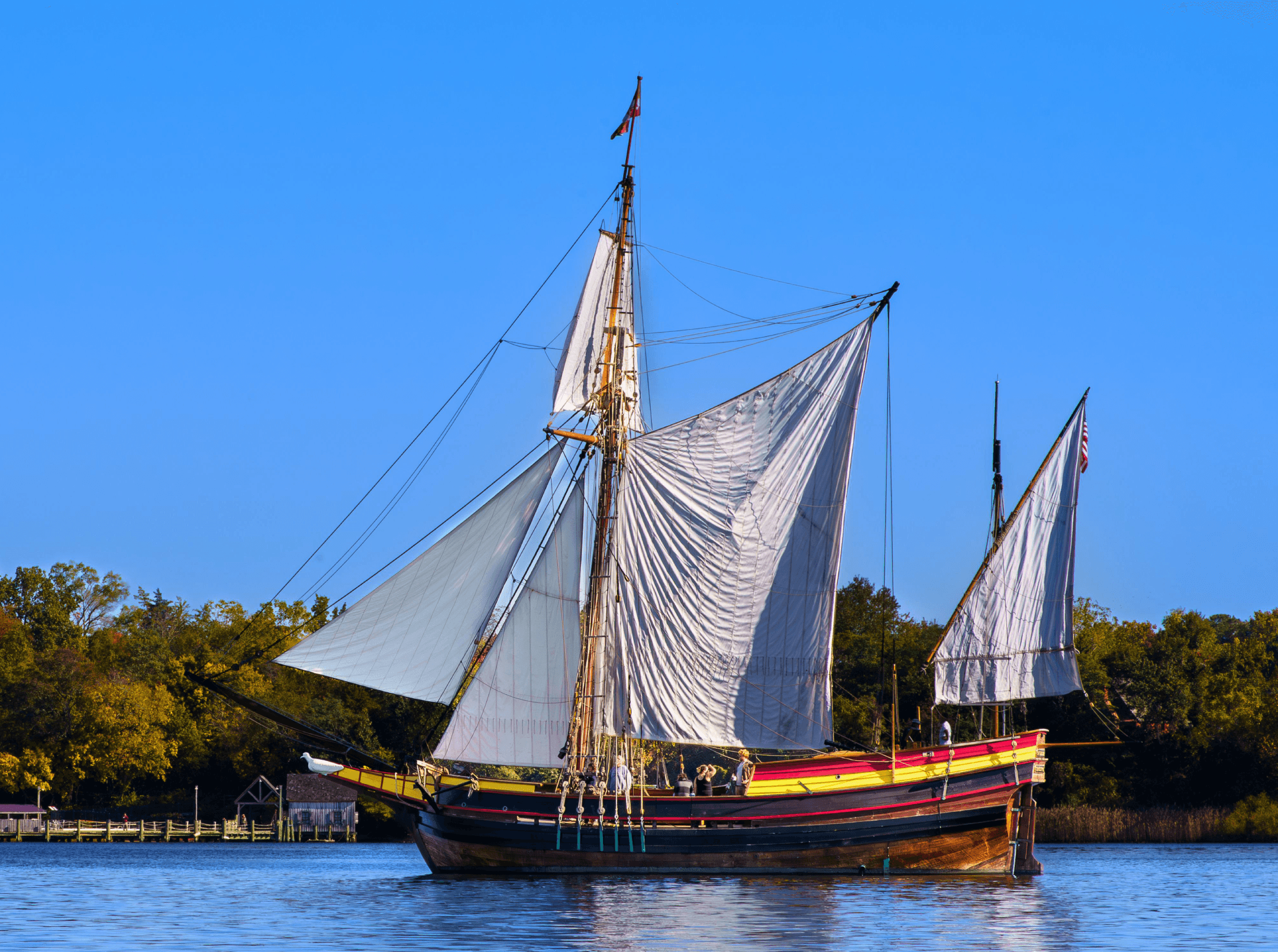
The Maryland Dove docked at Historic St. Mary’s City, Maryland. This ship is a reconstruction of the Dove, a 17th-century trading vessel that, alongside the passenger ship the Ark, carried colonists to found Maryland in 1634. Image credit: Jenn Dorsey, Historic St. Mary’s City.
Key Takeaways
|
Nearly four centuries ago, a small group of English and Irish settlers stepped ashore on the southern tip of Maryland and founded a colony they called St. Mary’s City. Many came seeking religious freedom, others arrived as indentured servants. Over the years, a significant number of these early colonists were buried at the site of the 17th-century Brick Chapel, but their names have since been lost to time.
Now, a new study published in Current Biology and co-led by researchers at the 23andMe Research Institute, Harvard Medical School, and the Smithsonian Institution’s National Museum of Natural History is helping restore their stories. With the support of Historic St. Mary’s City, the researchers analyzed the genomes of 49 individuals buried in St. Mary’s City’s Chapel Field. By comparing their DNA to more than 11.5 million consenting 23andMe research participants, the team traced where these colonists came from, mapped how their descendants spread across America, and, for the first time, proposed possible identities for three previously unknown individuals, including the colony’s second governor.
A short lived colonial capital
Established in 1634, St. Mary’s City was the founding English settlement in the colony of Maryland. It was envisioned by George Calvert, the first Baron Baltimore, as both an expansion of the King’s realm and a place of religious freedom, particularly for persecuted Catholics. The first settlers departed from the Isle of Wight aboard two ships, the Ark and the Dove in late 1633, and arrived at Maryland’s southern shore the following year.
Though its role as a capital city was short-lived (the seat of government moved to present-day Annapolis in 1695), St. Mary’s City left a lasting mark on American history. The Chapel Field cemetery, located at the site of the colony’s Brick Chapel, served as the primary burial ground for nearly a century. Despite existing written records and the ability of many present-day Americans to trace their ancestry to the historic city, many gaps remain in our knowledge of this founding population.

Ancient DNA meets the world’s largest genetics database
Researchers extracted ancient DNA from the bones of individuals buried at the site, then used an identity-by-descent approach to find genetic matches among living 23andMe customers who consented to research.
More than 1.3 million consented research participants share DNA with one or more of the St. Mary’s individuals. DNA sharing occurred at particularly high rates among participants with ancestry from western England and Wales. Several individuals in the study showed stronger genetic connections to Ireland, lending weight to accounts of Irish settlers among the earliest colonists.
Tracking a documented migration in DNA
One of the study’s most compelling findings is the detection of a clear genetic signal corresponding to a migration previously known only from historical records. Following the Revolutionary War, many Catholic families from St. Mary’s County faced economic hardship and growing religious discrimination. This prompted a wave of emigration to Kentucky primarily between 1780 and 1820. These settlers established themselves mainly in what are now Nelson and Washington counties.
When the research team mapped which 23andMe participants shared the closest genetic connections to the St. Mary’s individuals, they found enrichment around Louisville, Kentucky, highlighting the power of this approach.
Expanding the Calvert family tree
Among the 49 individuals studied, three of the burials were already known: Philip Calvert, the colony’s fifth governor, his first wife Anne Wolseley Calvert, and an infant, who was confirmed using DNA to be Philip Calvert’s son, likely from his second marriage. All three were buried in unusual lead coffins beneath the chapel floor.
By comparing their DNA to the remaining individuals in the study, the researchers identified three additional members of the extended Calvert family. The team also identified five other family groupings among the burials, including one that spanned three generations. Given the extraordinarily high mortality rates of the early colonial period, finding a multigenerational family within a single cemetery was a notable finding.
A new approach to identifying the nameless dead
Perhaps the most novel aspect of the study is what it demonstrates about using wide-ranging disciplines—from genetics and genealogy to archaeology, history, and osteology—to propose identities for otherwise unknown burials.
The study team invited consented 23andMe research participants who shared the strongest genetic connections to the St. Mary’s burials to contribute details from their own family trees. Researchers then searched for names that appeared across multiple genealogies and combined those findings with other anthropological evidence. Focusing on three closely related individuals, they found overlaps pointing to a single colonial family: Governor Thomas Greene, the second governor of the Maryland colony, his first wife Anne, and their son Leonard. This marks the first time ancient DNA has been used to propose identities for unknown historical individuals without any prior knowledge of who they might be, a significant milestone for the field.
Research built with community
Cutting-edge science wasn’t the only key to the success of this study. The early Maryland descendant community, including those who trace their lineage to the original Ark and Dove voyage, provided active support of the project.

The study also depended on the millions of 23andMe members who chose to participate in research. Participants who reported genealogical ties to 17th-century St. Mary’s City were significantly more likely to share DNA with the colonial individuals than those who did not, underscoring the real-world meaning of those genetic connections.
What this means for the future of ancient DNA research
The St. Mary’s City study represents something genuinely new: a framework that combines ancient DNA, archaeology, genealogical records, and a large modern genetics database to answer questions that written history could not resolve alone. The approach, particularly the method for proposing identities for unknown individuals, opens a door to similar work at countless other historical sites.
As the United States approaches its 250th anniversary, this research underscores the enduring connections between the nation’s earliest European settlers and millions of living Americans.