Key Takeaways
|
World Goth Day, celebrated every May 22nd, is typically a chance for fans of darkwave music, dramatic eyeliner and Victorian-inspired fashion to celebrate a subculture that has been going strong since the 1980s. This year, we’re marking the occasion with a slightly different kind of Goth story — one that predates the black lipstick by about 1,800 years.
This May, 23andMe is adding 35 individuals from a 2026 study to our Historical MatchesSM feature. These are not your weekend-festival Goths. These are the Goths, the actual Germanic people whose migrations and conflicts helped shape the final centuries of the Roman Empire.
Not the Same Goths (But Just as Interesting)
The modern goth subculture takes its name from the ancient Goths, though the connection is mostly aesthetic. The real Goths were a Germanic people who likely originated in Scandinavia and, over several centuries, migrated south through the Baltic region, eventually establishing themselves across a vast stretch of central and eastern Europe. By the 2nd century CE, Gothic communities occupied a dynamic frontier zone at the edge of the Roman Empire, trading with merchants to the south, maintaining ties with Baltic peoples to the north and absorbing influences from across an enormous geographic range.
Far from the brooding loners of pop culture imagination, the ancient Goths appear to have been remarkably cosmopolitan.
A Community at the Edge of the Roman World
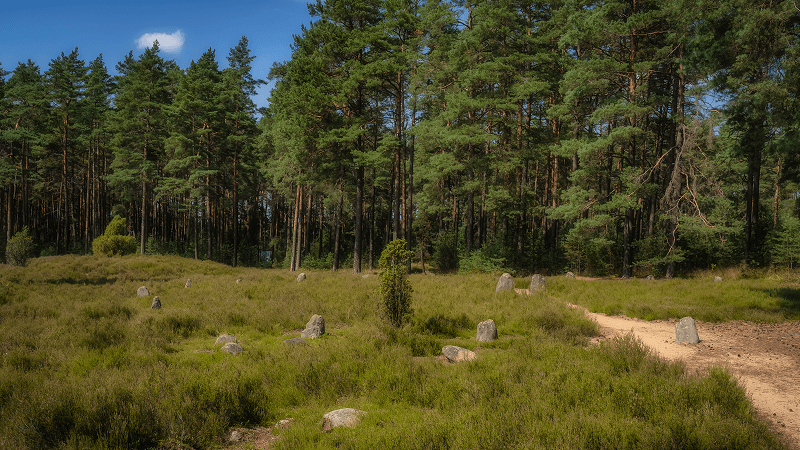
The individuals we added to Historical Matches this month were buried at a cluster of cemeteries in the Hrubieszów Basin of eastern Poland, belonging to what archaeologists call the Masłomęcz group, a well-documented Gothic community of the Late Iron Age. The site was an ideal candidate for ancient DNA analysis in part because an unusually high proportion of its burials were inhumations (intact body burials rather than cremations), providing enough preserved skeletal material for genome-wide sequencing.
The study, published in Genome Biology earlier this year, analyzed 43 individuals buried across several of these cemeteries, dating from approximately the late 2nd to the mid-4th century CE. Of these individuals, 35 had high-quality DNA sequences, and they have now been added to the Historical Matches feature.
The DNA: Cosmopolitan from the Start
The genetic results confirmed that the community’s ancestry was primarily derived from a Scandinavian-like source population, consistent with the Goths’ proposed northern origins. But that’s where any expectation of uniformity ends.
A striking proportion of individuals carried genetic signatures characteristic of populations from the eastern Baltic, the Balkans and the eastern Mediterranean, and there were more than 30 distinct mitochondrial haplogroups represented among this small group of individuals. This shows that the community was actively absorbing outsiders from across a wide geographic range.
One individual stood out above all. Rather than the Scandinavian ancestry typical of his community, roughly half of his DNA traced to populations associated with the Iberian Peninsula, about a third to populations from Imperial Roman Italy and the remainder to the Carpathian Basin of present-day Hungary and Slovakia, with no detectable Scandinavian ancestry at all. That an individual with such distinctly southern European roots appears among the very earliest burials at the site is a remarkable testament to just how cosmopolitan this Gothic community was from its very beginnings.
Social Bonds Over Family Ties
Perhaps the most unexpected finding concerned how individuals were buried. Despite sharing graves, co-buried individuals showed no evidence of close kinship with one another. This finding suggests that in this community, burial groupings may have reflected social bonds rather than family relationships. It’s a rare glimpse into how Gothic social life may have been organized beyond the household.
Learn More
23andMe+ Premium™ members can explore whether they share a genetic link to these ancient Goths, and hundreds of other historical individuals, through the Historical Matches feature.