
Key Takeaways
|
Summer is on the way, and we’d be lying if we said heading to the beach wasn’t at the top of our minds when preparing this month’s Historical MatchesSM update. So without further ado, we’d like to tell you the story of an aptly named Roman era woman: Beachy Head Woman.
She’s named after Beachy Head, a stretch of coastline on the south coast of England, and she lived during the Roman occupation of Britain. While her story doesn’t actually have anything to do with the beach (the site derives its name from the Old French for ‘beautiful headland’) it does involve a decade of conflicting scientific interpretations and a fascinating mystery that took until 2026 to resolve.
A Skeleton Without a Story
In 2012, researchers sorting through the archaeological collections in the south of England made an unexpected find: a skeleton in a storage box in the basement of Eastbourne’s Town Hall. The only information included with the box was a label reading “Beachy Head, 1959.”
So the team embarked on a series of archaeological and biomolecular analyses to learn about the identity of the skeleton inside. Radiocarbon dating indicated that the individual lived between 129 and 311 CE, during the Roman occupation of Britain. An analysis of the skeleton’s morphology revealed that it likely belonged to an adult woman, estimated to be between 18 and 25 years old at the time of her death.
Through an initial craniofacial analysis in 2013, researchers concluded that her skull had features consistent with sub-Saharan African ancestry. This preliminary interpretation spread fast. She was described in news outlets, books and educational materials as one of the earliest individuals of African descent identified in Roman Britain, and she entered public consciousness under the name “Beachy Head Woman”.
The Headline Ran Ahead of the Evidence
The strontium and oxygen isotope analysis carried out around the same time told a different story. Values from her tooth enamel were consistent with a childhood spent on the south coast of Britain, not overseas. Then, in 2017, a preliminary ancient DNA study generated tentative evidence of east Mediterranean ancestry, possibly Cyprus, but the dataset was too limited to settle the question.
Despite never being formally published, these findings circulated in the media regardless. For nearly a decade, who Beachy Head Woman really was remained an unresolved mystery.
A Local Woman All Along
In early 2026, researchers at London’s Natural History Museum finally helped to resolve this question. They published genome-wide ancient DNA data from Beachy Head Woman’s remains for the first time.
They showed that her ancestry was similar to local British and Northern European populations, with no detectable evidence of sub-Saharan African ancestry. Her mitochondrial haplogroup, K1a26, is also associated with Northern European and British populations and has been identified in individuals from rural Iron Age Britain.
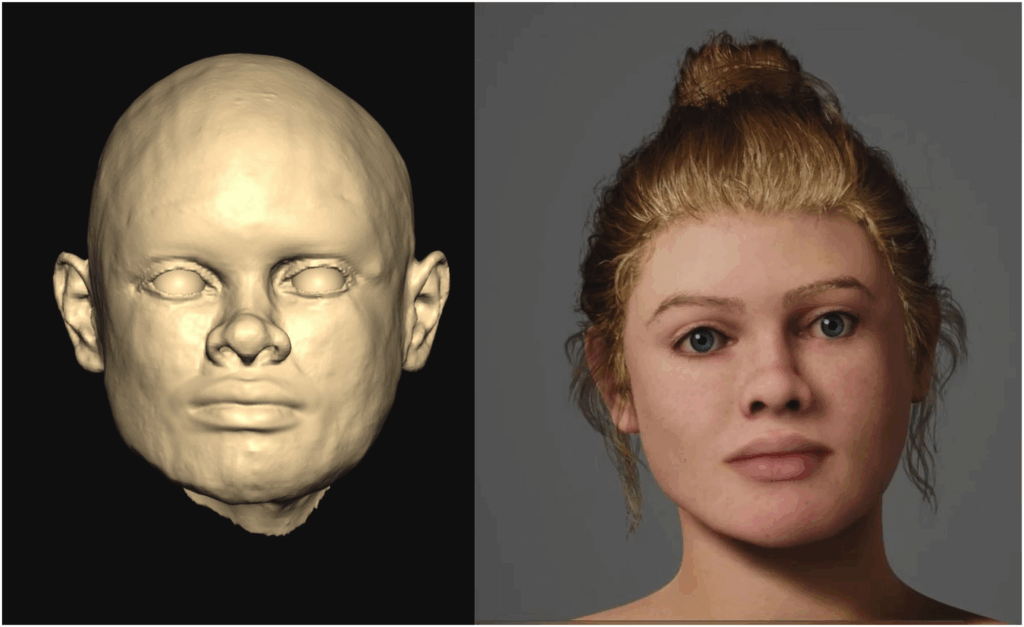
They even used her DNA to try to predict what she may have looked like, concluding that she likely had blue eyes, light hair and intermediate skin pigmentation — a significant departure from the original facial reconstruction. A new reconstruction was produced in light of the DNA results.
What Her Reassessment Reveals
Beachy Head Woman’s story has implications beyond her own origins. The craniofacial analysis that initially identified her as being of sub-Saharan African ancestry used methods that have since come under substantial scrutiny. The field of bioanthropology, like all scientific fields, is always evolving and has moved away from these kinds of ancestry estimation in recent years, in part because human skeletons are incredibly diverse; people with the same ancestry can have bone structures that look completely different from one another, making hard-and-fast classifications unreliable. The case of Beachy Head Woman is a concrete illustration of what can go wrong when those methods are applied without corroborating evidence.
Learn More
Want to see if you share a genetic connection to Beachy Head Woman, or with hundreds of other historical individuals? The Historical Matches feature is available to 23andMe+ Premium™ members.