Key Takeaways
|
Every time you get lab results back, you receive a number and a range. If the number lands inside the range, you’re “normal.” If it falls outside, something may need attention.
But those ranges have a blind spot: they’re often built on population averages. They don’t know your ancestry. They don’t know your genetic risk profile. For many people, “normal” doesn’t reflect them.
What would it mean to compare your lab results to people who are genuinely similar to you? That question is one that is motivating the 23andMe Research Institute to explore how genetics can personalize your lab results.
What is Cohort Comparison?
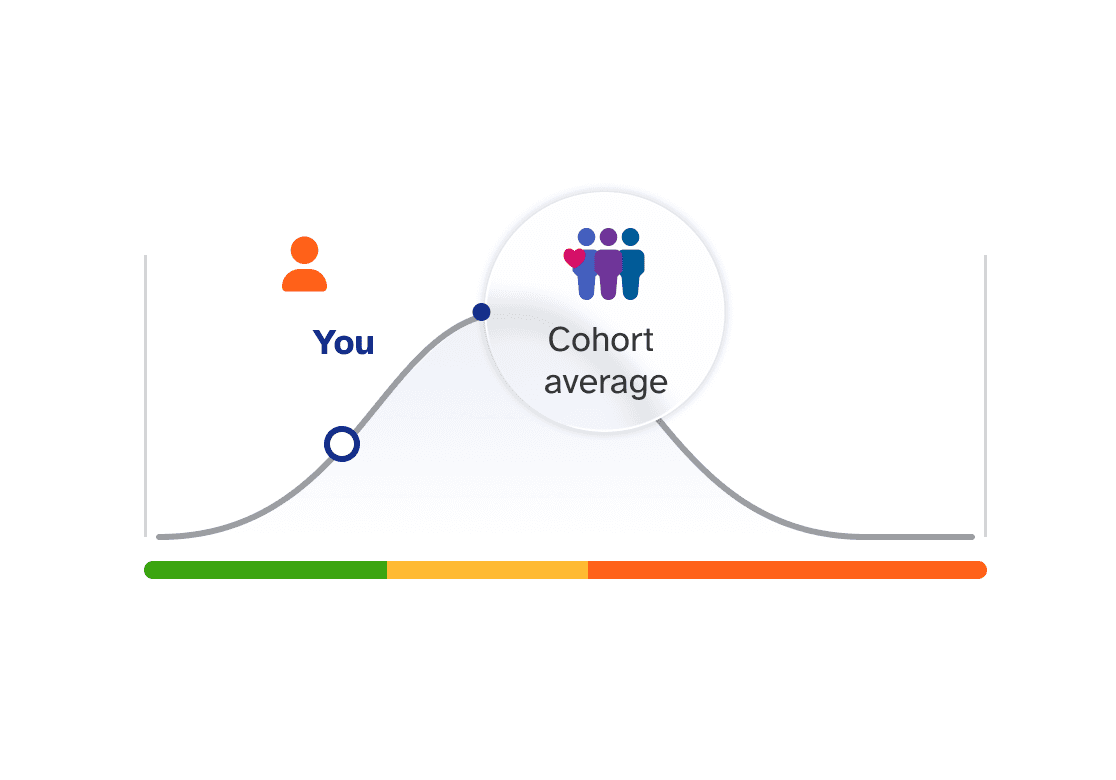
Cohort Comparison, now available for 23andMe+ Premium™ members in the Beta Testing Program, shows you how your health biomarkers compare to a group, or cohort, of people who resemble you: same age, sex, ancestry and genetic risk across key disease areas. You’ll see the typical distribution of biomarkers among people with characteristics like yours, and where your actual biomarkers fall relative to your cohort’s range.
This is what makes 23andMe different. Many reference ranges are adjusted based on age and sex, but 23andMe cohorts include your genetic ancestry and your health predispositions. When you look at your cholesterol results compared to your cohort, you’re not comparing yourself to “adults in your age range,” you’re comparing yourself to people whose bodies have similar genetic predispositions.
For some of your lab values, that comparison might be reassuring: you may find you’re doing better than your peers. For others, it might reveal something worth a closer look, even if your result sits technically “in range.” The goal is to give that number more meaning, not less.
What makes your cohort yours
Building a meaningful cohort requires walking a fine line. You need enough specificity to make the comparison personal. But you also need enough people to draw reliable conclusions.
Ideally, you’d compare yourself to people who share your age, sex, ancestral background, lifestyle, genetic risk profile, etc. not just one or two of those factors. The challenge is that the more specific the cohort, the harder it is to find enough people to populate it. Too narrow, and there’s not enough data to say anything meaningful.
That’s the problem 23andMe can solve. We have millions of consented research participants across diverse ancestral backgrounds many of whom have shared their real-world lab values and lifestyle data. We also have the scientific infrastructure to connect genetics, labs and health outcomes more accurately, a foundation built on over 300 peer-reviewed studies. So when we look at your cholesterol and compare you to “people like you” we mean people who are also 55-year-old East Asian females with the same increased likelihood to have high cholesterol.
Where this is today, and where it’s going
The longer-term vision is more ambitious. We want to show you how the lab values of your cohort change over time, and what some in your cohort did to change their trend.
This is cutting-edge genetic research happening in real time, and Beta participants are a part of it. What’s clear? What’s confusing? What do you wish it could tell you? Your feedback shapes what this becomes next.
If you’re a 23andMe+ Premium member Cohort Comparison is available now in Beta on desktop and iOS via your AI Health Summary.
If you’re not already a 23andMe+ Premium member, learn about all the additional features members receive.
The science behind this feature was built, in part, from data contributed by 23andMe research participants. We’re sharing this early version because we think you deserve to see what that science looks like when it’s pointed back at you, and because your feedback is how we make it better.
*Unfortunately this feature is not yet available on Android devices — we are working on it!