
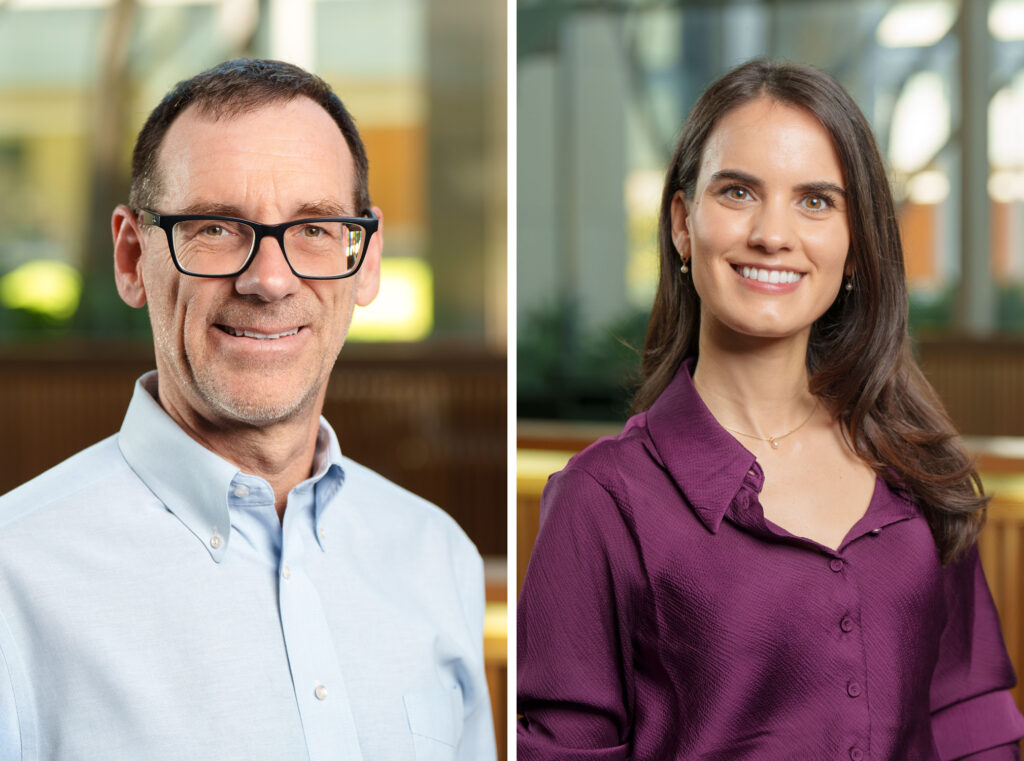
Since 2014, a powerful collaboration between Abraham Palmer, Ph.D. and Sandra Sanchez-Roige, Ph.D. at the University of California San Diego (UCSD) and 23andMe has been at the forefront of understanding how our DNA influences complex human behaviors. This enduring partnership has yielded groundbreaking insights published in high-impact journals such as Nature Neuroscience, the American Journal of Psychiatry, and others. Some of these studies include the first-ever genome-wide association study of delay discounting (the tendency to devalue larger future rewards in favor of smaller more immediate rewards), identification of more than a dozen variants associated with alcohol use disorder, the discovery of the shared genetic associations between loneliness and other health conditions, and one of the largest genetic studies on cannabis use.
A Shared Pursuit of Knowledge
At its core, this collaboration is driven by a shared vision: to identify the genetic underpinnings of behaviors that significantly impact human health. The goal is not just academic; it’s about identifying novel insights that can lead to better prevention, intervention, and treatment strategies for individuals struggling with substance use disorders. By understanding the genetic factors that contribute to these complex traits, researchers can pave the way for more personalized and effective approaches.
The Heart of the Research
These remarkable discoveries would be impossible without the generous contributions of 23andMe research participants. Millions of individuals have voluntarily consented to share their de-identified genetic and health data, providing the large sample sizes that are necessary to identify subtle yet significant genetic associations. This collective effort is the engine driving some of the largest behavioral genetic studies ever conducted.
A Testament to Enduring Science
Science, by its very nature, takes time. New discoveries often lead to new questions, fueling further exploration. The 12-year span of this partnership is a testament to the dedication and long-term vision of both 23andMe and Drs. Palmer and Sanchez-Roige. It represents a sustained commitment to tackling some of the most challenging questions in human behavior, a commitment that continues to bear fruit.
Proven Through Peer-Reviewed Science
The collaboration’s journey began when the first of three surveys was developed and deployed to 23andMe research participants in 2014. Just three years later, in 2017, the first peer-reviewed publication from this collaboration was published, showing that the online survey taken by 23andMe research participants can effectively be used to identify genetic factors underlying alcohol use disorder.
Since 2017, the momentum has only grown, with 16 additional papers already published and many more on the horizon. These papers represent a significant contribution to the global scientific community and stand as a direct result of the millions of research participants who have contributed their data and time.
Trusted Partners
From the perspective of Drs. Palmer and Sanchez-Roige, the decision to work with, and crucially, continue working with 23andMe for over a decade speaks volumes about the company’s rigorous research standards and commitment to scientific excellence.
“23andMe offers an unparalleled resource for genetic research,” says Dr. Palmer. “Their commitment to data privacy, ethical research, and the scale of their participant base makes them an ideal collaborator for tackling novel genetic questions that would be nearly impossible to answer elsewhere.”
“One of the reasons we’ve sustained this partnership for over a decade is 23andMe’s commitment to ethical oversight,” continues Dr. Palmer. “Every study we conduct is overseen by an independent Institutional Review Board (IRB), ensuring that participant privacy and informed consent are always the top priority. It allows us to focus on our research questions because we know 23andMe has systems in place to uphold the highest ethical standards.”
“What makes 23andMe a truly unique research environment is the strong engagement of the participants,” says Dr. Sanchez-Roige. “Unlike traditional studies that might take years to recruit a few hundred people, we can deploy a survey and receive thousands of thoughtful responses in a matter of days. This agility allows us to ask entirely new questions about behavior and environment, collecting the rich phenotypic data necessary to understand complex issues like aspects related to opioid use in ways we never could before.”
Dr. Sanchez-Roige continues, “working with the 23andMe Research Institute is more than just having access to a database; it has been a productive collaboration with outstanding colleagues. And the research participants are also devoted to contributing to science, meaning we aren’t just looking at static data; we are actively learning from millions of people who are as interested in these scientific answers as we are.”
Looking Ahead
As this research moves into the next phase of this partnership, the focus is expanding beyond genetics alone. Dr. Palmer says, “our recent work has demonstrated that answers to survey questions — even without genetic data — are powerful predictors for identifying individuals at risk for opioid use disorder.” Dr. Sanchez-Roige adds, “The data we’ve collected argues strongly for using a few questions to flag a small subset of individuals who are at high risk for opioid addiction before it’s too late. This project is ongoing, our survey on opioid use is still available for 23andMe research participants as we seek to obtain 500,000 completed responses.”
A Heartfelt Thank You to Our Participants
The true scale of this achievement is best measured in the time and dedication of research participants. “To put it in perspective, a single 15-minute survey that receives 500,000 responses represents the equivalent of 14.25 years of research participant time!” says Dr. Palmer. The ability to crowdsource data at this scale, in genotyped individuals, is what makes the 23andMe Research Institute a trusted research partner and a global leader in genetics and behavioral science.
The insights gained over the last 12 years are already reshaping how we understand the human experience. As we continue to ask new questions and uncover new associations, we move closer to a world where substance use disorders are met with better tools, deeper empathy, and more effective treatments.
Complete the Opioid Pain Medication Survey to help advance research efforts focused on the connection between genes and opioids.
Reference to UC San Diego does not imply endorsement or support of any product, service or company involved.
About the Collaborators
Abraham Palmer, Ph.D.
Dr. Abraham Palmer is a Professor in the Department of Psychiatry at the University of California San Diego. His current research emphasizes leveraging large-scale human genetic datasets alongside powerful preclinical models to identify risk genes, map biological pathways, and translate genetic discoveries into a deeper mechanistic understanding of addiction and related psychiatric outcomes. He has been a member of 23andMe since 2012 and has completed more surveys than 99% of 23andMe research participants. He is an avid cyclist who lives in San Diego, California with his wife, two teenaged children, two cats and one dog.
www.palmerlab.org
Sandra Sanchez-Roige, Ph.D.
Dr. Sandra Sanchez-Roige is an Associate Professor in the Department of Psychiatry at the University of California San Diego. Her research focuses on identifying the biological drivers that place people at risk for substance use disorders using genetics, genomics, medical bioinformatics, and cross-species translational approaches. She has been a member of 23andMe since 2016, is “likely to prefer chocolate over vanilla ice cream” and has a variant in the ACTN3 gene that means her “muscle composition is common in elite power athletes”, according to 23andMe reports. She co-leads the Sanchez-Roige Lab with Lisa, a talented British Shorthair cat, and Margot, a curious six-year-old girl, and Victor, a partner, slide beta-tester, and conference travel companion.
https://www.sanchezroigelab.org