Whether you’re a seasoned genetics explorer or just beginning to dive into your DNA, the most exciting part of the journey is often discovering how you’re connected to others.
Today, we’re thrilled to introduce DNA Relatives Clustering, a powerful new tool for 23andMe+ Premium™ members that helps you get more out of your genetic connections. Track down shared ancestors and visualize family branches seamlessly, instead of manually piecing together how your genetic relatives are related. This feature automatically organizes your DNA Relatives into visual groups based on their shared genetic connections.
Why It’s a Game-Changer
In the past, identifying which relatives belonged to your mother’s side versus your father’s side, or deeper into specific great-grandparent lines, required lots of manual searching.
Clustering does the heavy lifting for you. By providing a visual map of your genetic network, it’s easier than ever to find this information. It’s not just a list of names anymore; it’s a blueprint of your history.
How It Works: A Visual Map of Your Family
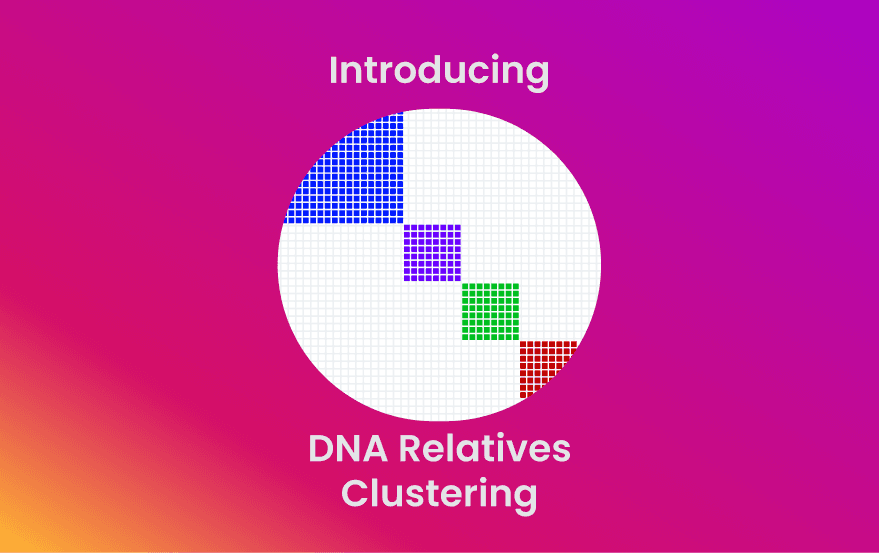
DNA Relatives Clustering generates an intuitive “map” of your family connections. By analyzing how your relatives share DNA with one another, not just with you, the tool creates a grid that brings your family branches to life.
- Clusters (Blocks of the Same Color): These represent a specific branch or part of your family. A cluster typically corresponds to people who share a set of specific ancestors, such as a pair of great-great-grandparents. Individual colored squares within a cluster show two people who share sufficient DNA with each other and with other relatives in that group. You can hover over each square to learn about the DNA shared between those two relatives.
- “Single Square” Clusters: Occasionally, you’ll see a single colorful square on the diagonal. These are DNA relatives who are connected to relatives in other clusters but don’t share DNA with enough people to be included in those clusters. Nevertheless they can help you figure out how the clusters relate to you and each other.
- Dark Gray Squares: These squares appear “off the diagonal” and represent people who share DNA but aren’t grouped into the same cluster. These can be useful for seeing how clusters reflect different branches of your family tree.
The Science Behind the Scenes
Our scientists are always looking for ways to make genetic data more actionable. DNA Relatives Clustering was inspired by the popular Leeds Method, a manual sorting technique used by genealogists.
However, we’ve taken it a step further. Our scientists designed a novel algorithm specifically for the 23andMe platform. While our tool uses optimal defaults to get you started, we’ve also included advanced filtering controls, allowing you to customize the parameters of your map more than any other tool on the market. You can change settings to adjust who gets included, make the clusters more closely or loosely related, or focus the analysis on just the DNA Relatives shared in common with another DNA Relative. Learn a little more about how to run clustering analyses, and have fun exploring!
Get Started
DNA Relatives Clustering is available now for 23andMe+ Premium members. Ready to see your family in a whole new light?